
Not only the product has to meet its functional requirement but for a successful product introduction also the industrialization requirements must be met. Industrial requirements are:
- Cost
- Product Cost
- Operational Cost
- Reliability
- Early failure mode
- Constant failure mode
- Wear Out
- Carbon Footprint
Cost
Product and operational cost are mostly set by the market. Operational cost is influenced by the reliability of the product and the Mean Time To Repair (MTTR). The first year the manufacturing related failures dominate where after the first year the constant and wear out failures contribute most. For each of the 3 reliability failure mode an expectation must be set.
Reliability
Constant Failure Defect Rate
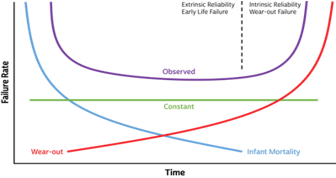
The Constant failure rate is mostly a measure for the expected failure mode of a part. Expectations are set in a percentage of the number of parts which are allowed to fail per year. An example could be that the expectations for the first 5 years a failure mode of 0.1%/year is set.
Manufacturing Part Quality
Manufacturing part Quality or infant mortality or early failure mode of the bathtub is caused by the manufacturing process. Constant and wear out failure mode are caused by the design and usage of the product. However the first year is the sum of the infant mortality rate (manufacturing part quality) + Constant failure rate. For all type of products such as electronics, mechanics, mechatronics, optics, gas and fluids, .. the rules differ. An example of a outcome could be a manufacturing part quality (infant mortality rate) of 0.05% or 500DPMO (ppm).
Wear Out Defect Rate
The wear out period is when the commercial or designed life stops and more and more failures manifest itself. This period is called the wear out phase and the product will not functioning at all any more.
This means that there must be an agreement on life expectation, failure rate acceptance during normal life and most important the acceptable number of failures during the first year of use. an example could be a product lifetime of 7 years.
Carbon footprint
Carbon footprint is the measure of how much greenhouse gases, like carbon dioxide and methane, are released into the atmosphere by the product manufacturing. Carbon footprint is mostly set based on previous products. An example could be a carbon footprint of 100 CO2 eq kg.
Consultancy
Manufacturing Risk Mitigation consultancy helps with setting the required specifications. Without a target it’s difficult to decide when being successful.